Organic chemistry is fun.
Let's teach it that way.
Book 1: Welcome to Organic Chemistry
Step into the colorful, captivating world of organic chemistry with Welcome to Organic Chemistry, the first book in an exciting graphic novel series. Meet a cast of lively atoms, bold molecules, and quirky reaction mechanisms as they navigate the fundamentals of organic chemistry—from atomic structure to bonding and functional groups.
Designed to make learning fun, this visually rich and approachable introduction turns daunting concepts into an engaging narrative. Whether you're a student new to chemistry or a science lover looking to explore, this book will welcome you to the world of organic chemistry with humor, clarity, and unforgettable illustrations.Perfect for readers of all levels, Welcome to Organic Chemistry transforms science into an adventure worth diving into!
This is book 1 in a series of 5. This book is 16 pages and covers fundamental concepts for introductory organic chemistry including: What does organic mean? Why is carbon special? Nomenclature, atomic orbitals, hybridization, and molecular orbitals. This work was designed and developed by Anita Mattson (USA) and illustrated by Anton Brand (UK). Note that this work is copyrighted and cannot be reproduced. Thanks for your support!
Book 2: All About Acids
Organic Chemistry Book 2: All About Acids is where protons get personality, pKa finally clicks, and Goldilocks and the Three Bases steal the show. Yes — that Goldilocks. Because not all bases are created equal: one’s too strong, one’s too weak, and one is juuuust right. Through bold visuals and playful storytelling, this graphic novel untangles acid strength, conjugate acids and bases, resonance stabilization, inductive effects, hybridization, and equilibrium — without the memorization meltdown. Instead of guessing which way a reaction goes, you’ll start reasoning it out. Instead of fearing acid–base questions, you’ll spot patterns instantly. Whether you’re prepping for an exam, teaching the fundamentals, or finally trying to understand why that proton leaves in the first place, All About Acids turns one of organic chemistry’s most tested topics into something clear, logical, and unexpectedly fun.
This is book 2 in a series of 5. This book is 16 pages and covers fundamental concepts for introductory organic chemistry including: What does organic mean? Why is carbon special? Nomenclature, atomic orbitals, hybridization, and molecular orbitals. This work was designed and developed by Anita Mattson (USA) and illustrated by Anton Brand (UK). Note that this work is copyrighted and cannot be reproduced. Thanks for your support!
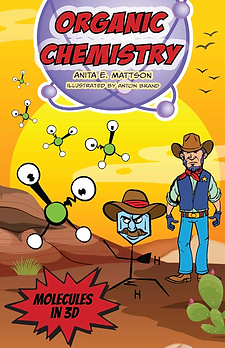
Book 3: Molecules in 3D
Organic Chemistry Book 3: Molecules in 3D takes one of the most conceptually challenging areas of introductory organic chemistry — molecular geometry and stereochemistry — and makes it visually intuitive. Through carefully designed graphics and narrative-driven explanations, this installment helps readers build a true three-dimensional understanding of structure, rather than relying on memorized rules.
Wedges and dashes become spatial relationships. Newman projections become tools for predicting stability. Concepts like chirality, enantiomers, diastereomers, conformational analysis, and R/S assignment are presented in a way that emphasizes reasoning and pattern recognition over rote procedures. Because structure governs reactivity, mastering three-dimensional thinking is essential for understanding mechanisms, selectivity, and molecular behavior. Molecules in 3D is designed to help students see what is happening in space — developing the mental rotation skills and conceptual clarity that organic chemistry demands.
Ideal as a study companion, visual textbook supplement, or reinforcement tool, this graphic novel supports deeper comprehension while keeping the material engaging and accessible.
This is book 3 in a series of 5. This book is 16 pages and covers fundamental concepts for introductory organic chemistry including: What does organic mean? Why is carbon special? Nomenclature, atomic orbitals, hybridization, and molecular orbitals. This work was designed and developed by Anita Mattson (USA) and illustrated by Anton Brand (UK). Note that this work is copyrighted and cannot be reproduced. Thanks for your support!
Book 4: The SN2
Organic Chemistry Book 4: The SN2 dives deep into one of the most fundamental—and beautifully precise—reactions in organic chemistry. This graphic novel unpacks the bimolecular nucleophilic substitution mechanism step by step, showing exactly how and why backside attack happens, what controls reaction rate, and how structure governs outcome.
Through clear visuals and narrative explanation, readers explore nucleophilicity, leaving group ability, solvent effects, steric hindrance, and the hallmark inversion of configuration. Rather than memorizing that “SN2 equals inversion,” you’ll see the geometry of the transition state, understand the kinetic dependence on both reactants, and recognize when the reaction pathway is favored—or blocked.
Because substitution reactions form the backbone of synthetic strategy, mastering the SN2 mechanism builds a foundation for predicting reactivity and designing transformations. The SN2 is designed to strengthen mechanistic reasoning, connect structure to outcome, and transform a classic reaction from a checklist item into a logical, visual process you can confidently analyze.
This is book 4 in a series of 5. This book is 16 pages and covers fundamental concepts for introductory organic chemistry including: What does organic mean? Why is carbon special? Nomenclature, atomic orbitals, hybridization, and molecular orbitals. This work was designed and developed by Anita Mattson (USA) and illustrated by Anton Brand (UK). Note that this work is copyrighted and cannot be reproduced. Thanks for your support!