Catalyzing Organic Chemistry Education
I love catalysts.
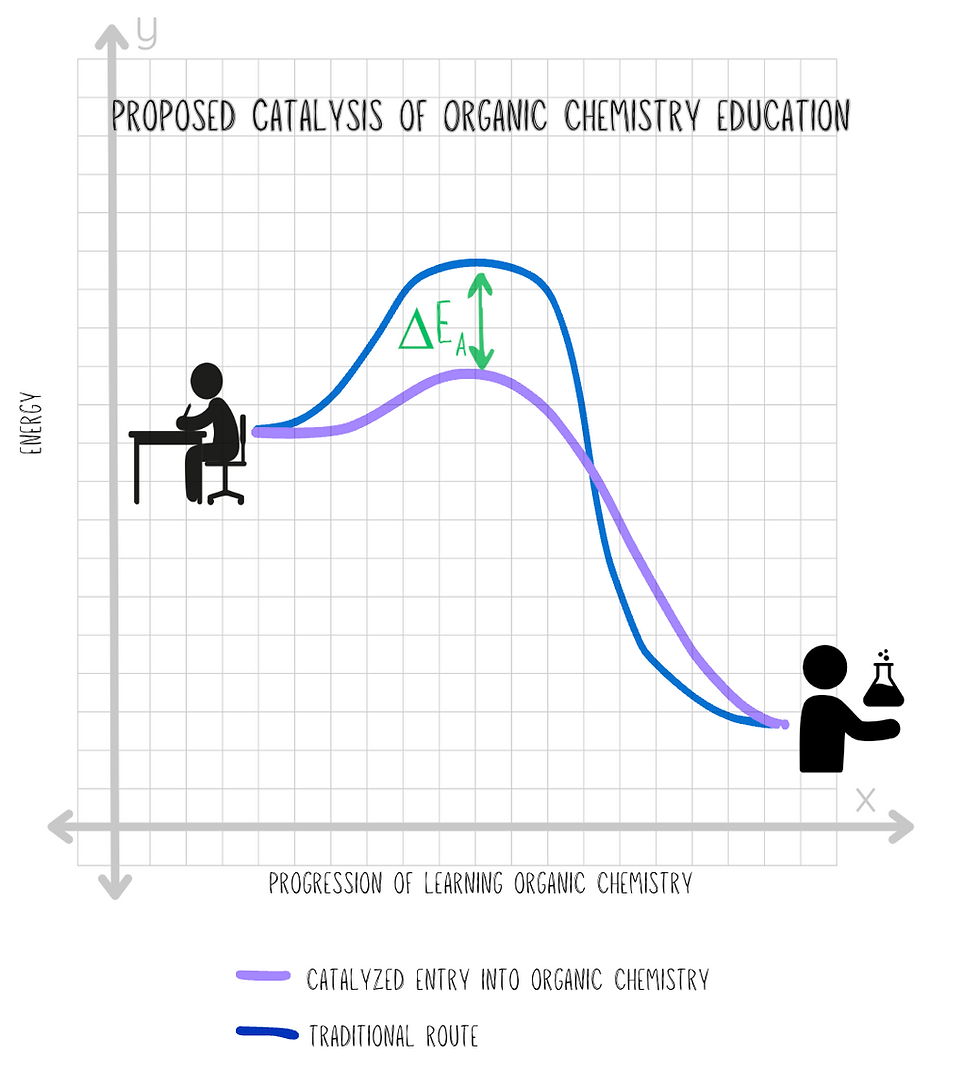
In chemistry, catalysts make the impossible possible. They accelerate reactions that might otherwise take years, lowering the energy barrier between where we are and where we want to go.
A catalyst doesn’t change the destination of a reaction — it simply makes the transformation easier to reach.
The more time I spend thinking about chemistry, the more I realize this idea extends far beyond molecules.
It applies to people, too.
Catalysts in the Classroom
Organic chemistry has a reputation for being intimidating. Many students walk into their first class already convinced that it will be the hardest course they will ever take.
But what if learning chemistry isn’t supposed to feel like pushing a reaction uphill alone?
What if the right teaching approach could act as a catalyst?
A good educational catalyst lowers the barrier to understanding. It helps students move from confusion to clarity faster. Instead of memorizing reactions, they begin to see the patterns and logic that make organic chemistry such a beautiful subject.
When that happens, something remarkable occurs: students begin to feel capable.
Confidence, like chemistry, often just needs the right catalyst.
Graphic Novels as Educational Catalysts
The idea of catalysis has influenced how I design my own teaching tools.
One of the most exciting approaches I’ve explored is using graphic novels to teach organic chemistry.
Stories and images have a powerful ability to lower the barrier to entry for complex ideas. When reaction mechanisms become characters and transformations become narratives, students interact with chemistry differently. Sometimes the students start to see themselves as part of the field in a way they had not experienced before.
In this way, the graphic novels act as catalysts for learning.
They don’t change the chemistry itself — the reactions, the mechanisms, and the underlying theory remain the same. But they lower the activation energy required for students to engage with the material.
Suddenly, organic chemistry becomes something students can step into rather than something they feel locked out of.
Catalyzing Belonging in Chemistry
Perhaps the most powerful aspect of catalytic teaching is that it creates access.
When the barriers to understanding are lowered, more students can see themselves as scientists. More voices can participate in the conversation. More perspectives can shape the future of the field.
My hope is that tools like graphic novels can help catalyze not just understanding, but belonging in chemistry.
The truth is that chemistry needs more minds, more creativity, and more curiosity.
Sometimes all it takes is the right catalyst.

Comments