On the Activation Energy of Learning Chemistry
Updated: Mar 12

Chemistry is often focused on the science of transformation.
Atoms rearrange. Bonds break and reform. Molecules become something entirely new. The discipline has a simple but powerful idea: change is possible.
In the laboratory, we know that transformations depend on conditions. Temperature, solvent, catalysts, and other aspects of the environment determine whether a reaction proceeds easily—or not at all.
I've started to wonder if maybe something similar happens in the classroom.
Students entering a chemistry course are also in the middle of transformations. They are not just learning mechanisms or memorizing reactions. They are becoming something: scientists, doctors, engineers, teachers—or sometimes simply people who believe they can understand science.
And just like chemical reactions, these transformations depend heavily on the environment.
The Hidden Variable in Chemistry Education
For decades, chemistry courses have often been framed as intellectual proving grounds. Organic chemistry maybe among the worst in terms of its reputation as a "weedout" course. Students hear stories long before they ever take the class:
Organic chemistry is brutal. Most people fail. Only the smartest survive.
These narratives quietly shape expectations. Many students walk into their first organic chemistry course already convinced that they are outsiders.
Before they even attempt to understand resonance or reaction mechanisms, they are asking a deeper question:
Do I belong here?
When that question lingers unanswered, learning becomes harder. Not because the material is impossible, but because the psychological barrier to engaging with the material becomes enormous.
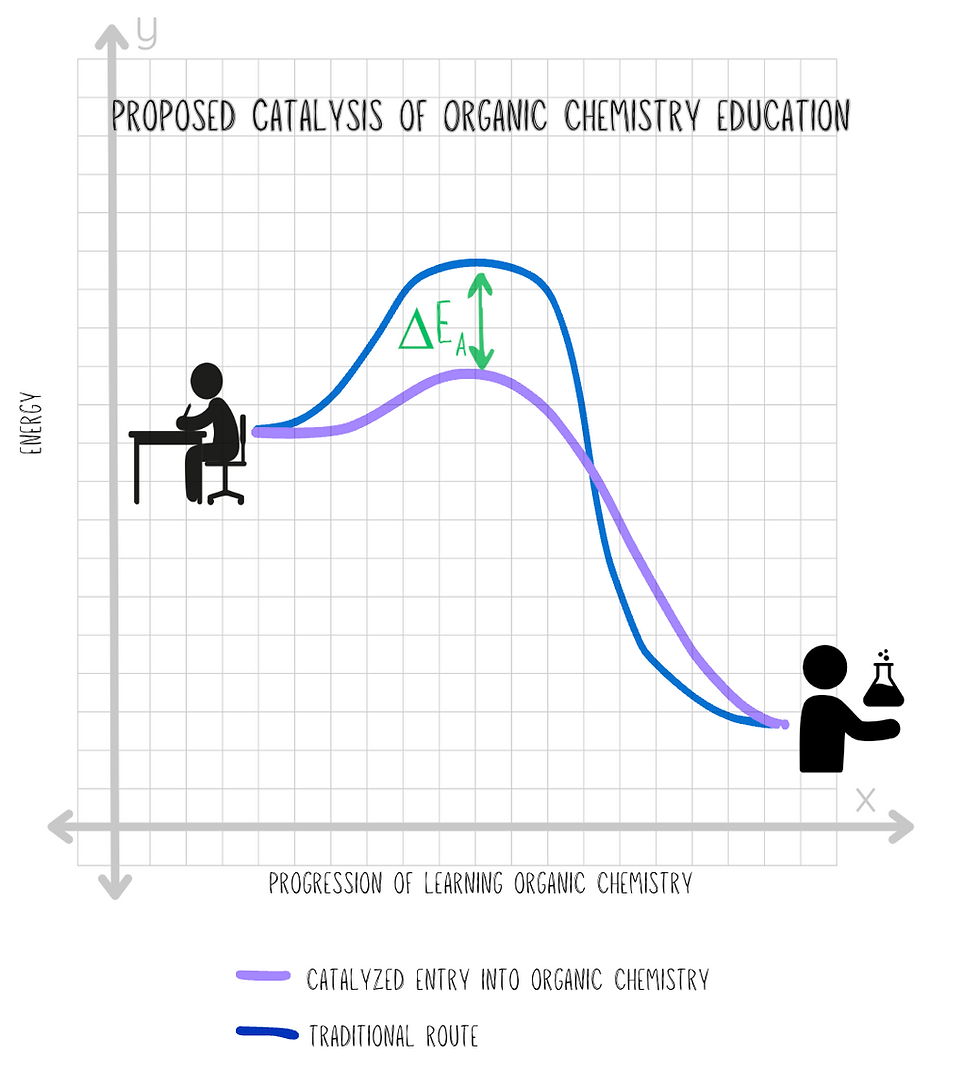
In chemistry terms, the activation energy for learning becomes very high.
Activation Energy in Educational Transformations
In chemistry, we carefully design strategies to lower the activation energy of molecular transformations.
Catalysts are introduced. Solvents are optimized. Temperatures are adjusted. Entire research programs are devoted to discovering conditions that make difficult reactions possible.
Lately, I’ve started wondering if something similar might apply to education.
Perhaps it is also possible to design strategies that lower the barrier to educational transformations.
Students do not arrive in our classrooms as blank slates. Many carry uncertainty about whether they belong in science at all. When that uncertainty is high, the activation energy required to engage with difficult material becomes enormous.
But the learning environment can change that barrier.
A supportive classroom culture. Representation in science. Storytelling and humor. Collaborative problem solving.
Each of these elements can reshape the space between the student and the subject.
Humanizing Chemistry
One of the most powerful ways to create belonging is to humanize the discipline.
Chemistry is often taught as a rigid system of rules, mechanisms, and problem sets. While those elements are important, they can unintentionally obscure the creativity and humanity behind the science.
Stories, visual narratives, and artistic approaches can help bridge that gap.
When chemistry is presented through narrative or visual storytelling - such is in a graphic novel - students see that the field is not just a collection of equations, it is a human endeavor filled with curiosity, failure, discovery, and imagination.
For many students, this approach helps to make chemistry feel accessible rather than intimidating.
Belonging begins to form.
The Future of Chemistry Education?
If chemistry is an enabling science of transformation, perhaps chemistry education should embrace the same philosophy.
Instead of asking which students are strong enough to endure the discipline, educators might ask a different question:
How can we design environments where more students can transform into chemists?
Small choices matter.
Encouraging questions. Celebrating curiosity. Integrating art, narrative, and creativity. Showing students that chemistry belongs to them.
And when the barrier to belonging drops low enough, maybe something extraordinary will happen.
Students might stop asking whether they belong in chemistry.
They might start asking what chemistry can help them transform next.
Comments